EU PFAS Ban August 2026: What UK Foodservice Operators Need to Source Now
Bagasse moulded fibre uses natural fibre structure for grease resistance, with no intentionally added PFAS.
From 12 August 2026, food-contact packaging placed on the EU market cannot contain PFAS above 25 ppb for any single substance (targeted analysis), 250 ppb for total targeted PFAS, or 50 ppm total fluorine including polymeric PFAS. UK rules do not match this yet, but DEFRA's February 2026 PFAS Plan signals tighter UK testing and possible REACH restrictions. If you ship to the EU, supply UK brands that export, or simply want to de-risk your menu, you need to be reformatting your packaging spec this summer.
At a glance: what's changing and what to do
Deadline EU PFAS limits apply from 12 Aug 2026 with no grandfathering for stock already in market.
EU limits 25 ppb single PFAS, 250 ppb sum, 50 ppm total fluorine in food-contact packaging.
UK position No statutory limit yet. DEFRA PFAS Plan (Feb 2026) starts testing food contact materials; UK REACH restriction under review.
Action Audit grease-resistant paper, switch lines that fail to bagasse, aqueous-coated paper or seaweed-based barrier coatings.
What PFAS are and why they ended up in your packaging
PFAS (per- and polyfluoroalkyl substances) are a family of around 14,000 synthetic chemicals nicknamed "forever chemicals" because they don't break down in the environment. In foodservice packaging, they were the easy answer for one problem: keeping grease, oil and moisture from punching through paper. A thin PFAS coating gave a chip wrapper, a burger box or a pastry bag the barrier of plastic without the look or weight of plastic.
The problem is that the same stability that makes them useful in packaging makes them dangerous in the body and in waste streams. A 2020 study cited by the campaign group PFAS Free UK found PFAS in packaging from 8 of 9 major UK supermarkets and in 100% of the takeaways tested. More recent UK monitoring referenced in the DEFRA PFAS Plan suggests PFAS presence in mainstream UK takeaway boxes has fallen since 2020. The risk now sits in legacy products and imported lines.
The 12 August 2026 EU rule, in plain English
The EU's Packaging and Packaging Waste Regulation, Regulation 2025/40, entered into force in February 2025. From 12 August 2026, food-contact packaging cannot be placed on the EU market if PFAS exceed three thresholds.
25 ppb Any single PFAS substance, targeted analysis (excludes polymeric PFAS)
250 ppb Sum of all targeted PFAS (excludes polymeric PFAS)
50 ppm Total fluorine / total PFAS including polymeric PFAS
Two practical points. First, there is no transition period. Stock manufactured before 12 August 2026 still cannot be placed on the market after that date if it fails the limits. Second, the regulation comes with a stepwise testing approach because validated analytical methods are still being finalised, as explained in Food Safety Magazine's deadline guide. The Step 1 screen is total fluorine: if a sample is under 50 ppm total fluorine, it passes without further work.
UK rules: looser today, almost certainly tighter tomorrow
The UK has not adopted the EU thresholds. The closest equivalent right now is voluntary: EN 13432 compostability caps total fluorine at 100 ppm, a limit baked into TUV Austria's OK Compost certification schemes from January 2022. If your packaging carries a current OK Compost mark, it has already been screened to that 100 ppm ceiling.
Beyond that, the UK landscape is changing. DEFRA's first PFAS Plan, published 3 February 2026, commits to four packaging-relevant actions: developing PFAS testing methods for food contact materials, expanding sampling, considering a UK REACH restriction on PFAS in consumer articles including packaging, and reviewing dietary exposure data. None of that is a hard limit yet, but combined with retailer pressure and the EU divergence problem for exporters, the direction is one-way.
Where PFAS hides in foodservice packaging
If you run a cafe, a takeaway or a multi-site delivery brand, these are the lines worth checking with your supplier:
Grease-resistant paper wrappers and bags for chips, burgers, fried chicken, doughnuts, pastries, and any deep-fried item. These historically carried PFAS-based grease coatings.
Microwave popcorn bags and similar oven-stable papers. Less relevant to most foodservice operators but worth flagging if you supply offices or hotels.
Older "compostable" bagasse and moulded fibre lines from non-certified manufacturers. Bagasse fibre itself is PFAS-free, but some legacy products had PFAS coatings added on top for extra grease resistance. EN 13432 certified bagasse meets the 100 ppm fluorine ceiling.
Imported takeaway boxes without OK Compost or BS EN 13432 certification. The 2020 study cited above found PFAS in the majority of UK takeaway boxes tested at the time; today's UK supply is cleaner, but unbranded imports remain the highest-risk line.
PFAS-free fibre containers rely on sugarcane bagasse, kraft paperboard and aqueous coatings instead of fluorinated chemicals.
PFAS-free alternatives that actually work in a busy kitchen
You have three serious options to replace PFAS-coated paper, and they handle grease in different ways.
Bagasse and moulded fibre. Sugarcane bagasse is the residue left over after juice is pressed for sugar. It is a fibre, not a coating, so grease resistance comes from the structure of the moulded wall itself rather than a chemical layer on top. Tocco and Kemira both rank bagasse as a first-tier replacement for fried foods and saucy dishes. Look for EN 13432 or BPI certification on the sales sheet; that confirms total fluorine under 100 ppm.
Aqueous-coated paper. Water-based dispersion barriers from suppliers like Solenis (TopScreen) and Koehler Paper replace plastic and PFAS coatings on kraft and greaseproof paper, as documented by Food Engineering. Aqueous coatings give you grease and moisture resistance without intentionally added PFAS, and the paper stays recyclable in standard paper streams (unlike PE-lined paper, which mostly does not).
Seaweed-based barrier coatings. UK company Notpla won the Earthshot Prize in 2022 for its seaweed coating that replaces plastic and PFAS lining on takeaway boxes. Premium price point, strong sustainability story, currently best for brands that lead on environmental positioning.
What to do this summer if you sell into the EU or want UK headroom
Three steps, in this order:
Audit your current SKUs against your supplier's PFAS test data. Ask for a PFAS test report or a written PFAS-free declaration for every line where grease resistance is part of the spec. Reputable manufacturers can produce this within a working week.
Replace any line that fails or has no test data. Prioritise the lines that touch hot, greasy or saucy food: chip wrappers, burger boxes, fried chicken trays, taco wraps, sandwich liners.
Update your spec sheets and supplier contracts. Add a clause requiring conformity with EU Regulation 2025/40 PFAS limits, supported by current test data, for any product placed on the EU market after 12 August 2026. UK-only buyers can use EN 13432 / OK Compost certification as a practical proxy.
Aqueous-coated kraft paper bags give grease and moisture resistance without intentionally added PFAS.
Bakery, pastries, sandwiches Greaseproof kraft paper bags with aqueous coating. See our bakery collection.
Saucy hot food, curries, noodles Bagasse soup bowls or kraft paper boxes with aqueous lining. See our soup and salad range.
Carrier bags Kraft paper carrier bags, twisted handle or SOS. See our bags collection.
Frequently asked questions
Does the EU PFAS ban apply to me if I only sell in the UK? Not directly. The 12 August 2026 limits apply to packaging placed on the EU market. If you only sell UK domestic, you have more time, but DEFRA's PFAS Plan, ASA scrutiny of green claims, and retailer pressure are all pushing UK supply chains in the same direction. Switching now removes a known regulatory risk for very little incremental cost.
Is bagasse always PFAS-free? Bagasse fibre itself contains no fluorinated chemicals. The question is whether the manufacturer adds a PFAS coating for extra grease resistance. EN 13432 / OK Compost certified bagasse caps total fluorine at 100 ppm, well inside even strict reading of the EU rule. Always ask for the certificate.
Are PLA-lined paper cups PFAS-free? The PLA lining itself is PFAS-free, but PLA cups whose dominant material is plastic remain liable for the UK Plastic Packaging Tax when the plastic component contains less than 30% recycled content, because PLA is classified as plastic for PPT purposes. PFAS-free does not equal tax-free or home-compostable. See our UK Plastic Packaging Tax guide for the tax side.
What's the difference between "PFAS-free" and "fluorine-free"? Most regulators use them interchangeably for food contact materials. The EU rule sets a total fluorine ceiling of 50 ppm because fluorine is the analytical marker for PFAS. A product labelled "fluorine-free" or "no intentionally added PFAS" should pass.
Are aqueous coatings recyclable? Yes, generally. Aqueous (water-based) dispersion coatings let the underlying paper or board stay recyclable in standard kerbside paper streams, subject to your local council's rules. They are not the same as PE (polyethylene) plastic lining, which causes problems in paper recycling.
Does microwaving release PFAS from coated paper? Microwave popcorn bags were the original PFAS food packaging concern because heat accelerates migration into food. Even at room temperature, PFAS can migrate, which is why the EU rule covers all food-contact packaging not just hot-fill formats.
How quickly can I switch? For lines where Element holds stock, you can switch on the next order. For custom-printed lines, the typical lead time is 6 to 10 weeks for printing plus shipping. If you sell into the EU, start the conversation with your supplier now to land replacement stock comfortably before 12 August 2026.
Where do PFAS go after the bin? That is the second reason the rule matters. PFAS persist in soil and water indefinitely, and contaminate the compost stream when "compostable" packaging carries fluorinated coatings. BIOPAP's policy paper sets out why the composting industry treats PFAS-containing items as non-compostable regardless of certification claims.
The 12 August 2026 deadline is real, with no grace period for stock in market. The UK rules will follow even if more slowly. Switching grease-resistant paper from PFAS-coated to bagasse, aqueous-coated paper or seaweed-based barriers takes a single conversation with your supplier. Browse our compostable foodservice range or ask us for PFAS test reports on any line you currently stock.
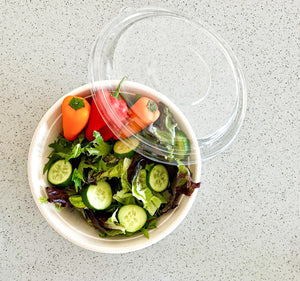
We've been very happy with these lids. They fit securely, are sturdy, and work perfectly with our salad bowls. Great quality product and reliable for takeaway and delivery orders. Will definitely purchase again.
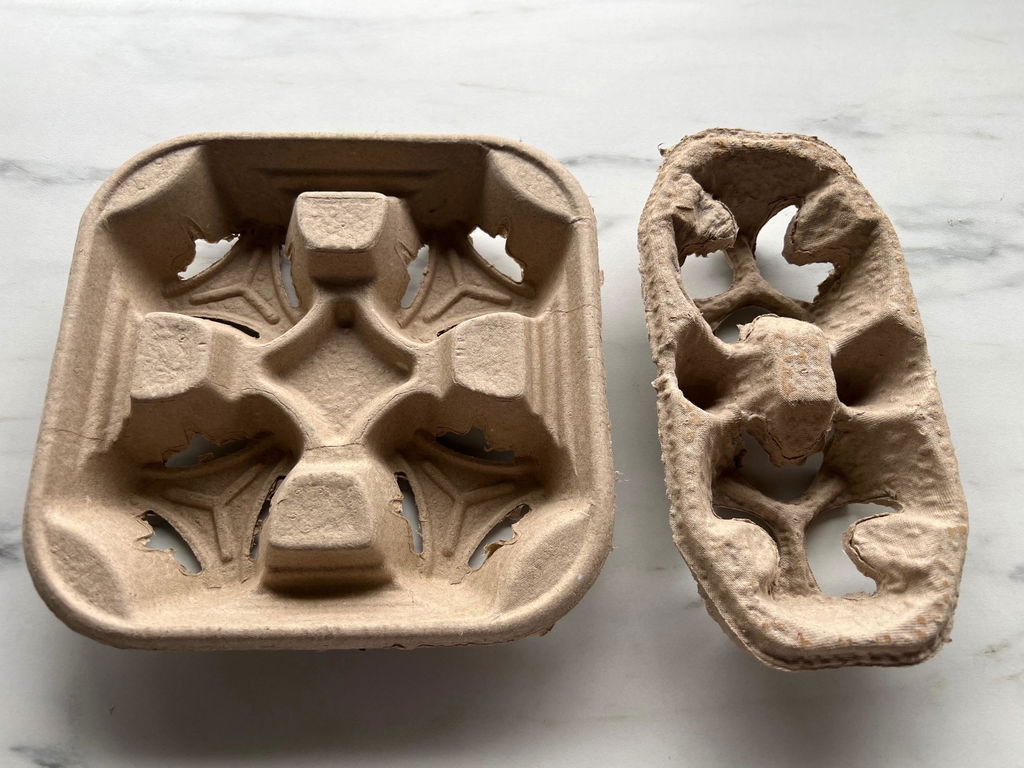
These are aesthetically ugly with brown stains, I get it probably recycled card pulp and it does the job of holding cups but I’m disappointed. Compared the 4 cup holders ones you sell, those are much nicer with cleaner edges and surfaces. I recommend you use the same supplier as the 4 cup design.