The 2026 UK cafe coffee cup decision is now four levers: construction, size, lining material, and lid system.
A UK cafe in 2026 needs to spec coffee cups across four levers: construction (single wall, double wall or ripple), size (4oz to 16oz with 8oz and 12oz doing most of the volume), lining material (PE, aqueous or bagasse, with PE-lined cups still dominant but losing ground on recyclability), and lid system (80mm, 90mm or 95mm rim, in PE, CPLA or bagasse fibre). This guide takes you through each lever with prices, regulatory context and a recommendation matrix at the end.
At a glance: the 2026 UK cafe cup spec
Construction Single wall (volume), double wall (premium), ripple (best insulation).
Lever 1: Construction - single wall, double wall or ripple
Construction affects three things customers can feel: how hot the cup is in the hand, how it photographs on Instagram, and how much you pay per piece. The choice is rarely about coffee quality - it is about cafe positioning.
Single wall. One layer of paper, lined inside with PE, aqueous coating or bagasse. The volume choice for high-throughput cafes, event catering, hotels and any operator running printed sleeves. Afida's UK guide calls 8oz the industry standard for flat whites and 12oz for everyday lattes. Cheapest per piece. Hot to the touch, so most operators pair with a corrugated sleeve.
Double wall. Two layers of paper bonded together with an air gap, no sleeve needed. Insulates well, feels premium in the hand, prints crisp. Standard for indie cafes and specialty roasters. Roughly 25-50% more per piece than single wall in equivalent volume.
Ripple (triple wall). An inner cup, outer cup and a corrugated middle ripple. Best insulation of the three, hands stay cool even at 92°C, distinctive corrugated outer that printers love. Roughly 50-100% more than single wall. Best for premium positioning where the cup is part of the brand experience.
Kraft paper cups give an earthy, natural feel - works best in indie and specialty cafe brands.
Lever 2: Size - what to stock for what menu
UK cafes typically stock three sizes, occasionally four. Skip anything outside this range unless you have a specific menu reason.
4oz Espresso, ristretto, macchiato. Low volume but high impact - signals serious specialty coffee. Often run by hand in-house only.
8oz Flat white, cappuccino, cortado. Industry standard. Should be 30-50% of your hot cup volume.
12oz Standard latte, large cappuccino, regular Americano. Should be your highest-volume cup, typically 40-60% of total.
16oz Large takeaway latte, mocha, hot chocolate, tea. 10-20% of volume; allows upsell pricing.
One non-obvious tip: standardising your sizes simplifies lid stock. If you run 8oz and 12oz, you may be able to use a single 90mm lid across both sizes depending on cup spec. If you add 4oz, you add an 80mm lid SKU. Each additional size carries a tail of sleeves, lids and box quantities behind it.
Lever 3: Lining material - PE, aqueous or bagasse
This is the single most consequential 2026 decision because it determines what happens to the cup after the customer drinks the coffee, what claims you can make on your menu, and whether your supply has any future-proofing against tightening UK regulation.
PE-lined paper. Polyethylene plastic lining on the inside of paper cup. The volume default for cheap takeaway cups. Reliable, leak-proof, hot-safe. The catch: a paper-and-plastic composite cannot be recycled in standard UK kerbside paper streams. The House of Commons Environmental Audit Committee's 2018 "Disposable Packaging: Coffee Cups" inquiry concluded that fewer than 1 in 400 disposable coffee cups (about 0.25%) are recycled in the UK, with around 4% of single-use cups in Scotland recycled per Keep Scotland Beautiful's Cup Movement. PE-lined cups remain liable for PPT if the plastic component exceeds 30% non-recycled content per HMRC's PPT rules.
Aqueous-lined paper. A water-based dispersion barrier replaces PE. Cups are recyclable in standard UK kerbside paper streams, subject to local council acceptance. Novorise's UK guide and Decent Packaging's launch article set out the technical detail: aqueous coatings are water-based, contain no PFAS or plastic film, and the underlying paperboard re-enters the paper recycling stream like any other paper product. About 10-20% more per piece than PE-lined cups, with the gap narrowing as volumes grow.
Bagasse (sugarcane fibre). Cups moulded from sugarcane fibre. Inherently compostable to EN 13432 (industrial) and often OK Compost HOME. No plastic content, so PPT-exempt. Heat tolerance to ~100°C. The trade-off is appearance: bagasse cups have a textured natural-fibre look and feel that some brands love and some find too rustic. About 20-40% more per piece than PE-lined.
Lid rim diameter (80mm, 90mm, 95mm) governs compatibility - never order lids by cup volume alone.
Lever 4: Lids - rim diameters, materials and seal types
The most common ordering mistake we see: ordering lids by cup volume (12oz, 16oz) instead of by rim diameter. Cup volume and rim diameter are not the same thing. Always check the rim spec.
80mm rim: Fits 4oz, 6oz and some 8oz cups. Tolerance ~±0.5mm. Use for espresso and small cappuccino sizes.
90mm rim: Fits 8oz, 10oz, 12oz and most 16oz cups. The single most-stocked lid in UK cafes.
95mm rim: Less common in the UK; used on some oversized 16-22oz cups and US-spec lines.
Lid material follows the cup decision:
PE / PS plastic lids: Cheap, robust, sip-through. Same recyclability problem as PE-lined cups in mixed-stream kerbside. PPT-liable.
CPLA lids: The standard compostable option. Industrial compostable only, still classified as plastic for PPT.
Bagasse fibre lids: Newer to the UK market. Compostable, PPT-exempt, but seal less reliably than CPLA on uneven rims - check sample before committing volume.
Seal type matters for delivery and walking customers. Sip-through (flat with a slot) is the cafe default. Spout lids work for handheld drinking. Sip-and-seal / reclosable lids reduce spill complaints for delivery riders and bike commuters; Siplock-style reclosable lids are increasingly the spec for delivery brands.
Sleeves vs double wall: when each makes sense
If you are using single wall cups, the choice is sleeves on demand or a corrugated kraft sleeve on every cup. The financial and brand-image numbers usually decide.
Sleeves on demand: Roughly 1-2p per sleeve, applied only when the customer holds the cup. Best when 60%+ of cups stay on premises (tray service) or when your menu skews to drinks under 65°C.
Sleeves on every cup: Looks consistent, eliminates the "can I get a sleeve" moment, but adds 1-2p per cup all-in. Worth it when 80%+ of cups are takeaway hot.
Switch to double wall: Adds 1-3p per cup depending on volume, eliminates the sleeve SKU entirely, looks premium. Pays back if your single-wall + sleeve combo cost more than equivalent double wall AND a sleeve simplification is worth the operational saving.
Custom branding: MOQ, lead time and ROI
Custom-printed cups are the cheapest piece of marketing real estate a cafe owns: every customer walks down the high street holding your logo for 15-20 minutes. The economics work if you have the volume.
MOQ: 10,000 to 25,000 cups for one-colour print is the typical UK minimum. Two- and three-colour prints push to 20,000-50,000.
Lead time: 6-10 weeks from artwork approval to delivered stock, longer if certified compostable substrate is shipping from outside the UK.
Design tips: Lock the logo on one cup orientation - the print runs once per cup; do not split a logo across the seam. Allow generous bleed at top and bottom. Vector artwork (AI or PDF) at 300dpi is the standard.
ROI: A 12,000-cup print run at a 1.5-2p premium over plain cups costs roughly £180-240 extra. If that drives a single new regular customer at £3 per visit, twice a week, you have paid for the print in 30-40 visits.
2026 UK cost benchmarks per 1,000 cups
These are typical UK cafe trade prices in 2026 for medium-volume buyers (10-50 cases at a time). Prices vary by supplier, customisation and contract; use these as a sanity check, not a quote.
8oz single wall, PE-lined plain ~£30-40 per 1,000
12oz single wall, aqueous-lined ~£45-60 per 1,000
12oz double wall, PE-lined plain ~£55-75 per 1,000
12oz ripple, kraft plain ~£65-90 per 1,000
90mm CPLA sip lid ~£20-30 per 1,000
Custom print uplift (1-colour, 12k MOQ) ~+1.5-2.5p per cup
Recommendation matrix: matching menu to cup spec
Specialty / indie cafe (low to medium volume) 12oz double wall aqueous-lined with custom one-colour print, CPLA lid. Browse our 12oz double wall range.
High street chain (high volume, brand-led) 12oz single wall aqueous-lined, two-colour print, 90mm CPLA lid, kraft sleeves on demand. See 12oz single wall.
Event catering / festivals 8oz and 12oz single wall plain, 90mm CPLA lid, no sleeves. Volume above all.
Eco-led brand (positioning on sustainability) Bagasse 8oz and 12oz with bagasse or CPLA lids. PPT-exempt, EN 13432, suits brand story.
Delivery / dark kitchen 12oz double wall aqueous-lined with reclosable / Siplock-style 90mm lid; insulation plus spill protection in transit.
Speciality espresso bar 4oz espresso + 8oz flat white, both double wall white with subtle one-colour brand mark. 4oz espresso cup.
Frequently asked questions
Are paper coffee cups recyclable in the UK? Most PE-lined paper cups are not recyclable in standard kerbside paper streams because the plastic lining bonds to the paper. The House of Commons Environmental Audit Committee's 2018 'Disposable Packaging: Coffee Cups' inquiry concluded that fewer than 1 in 400 disposable coffee cups (about 0.25%) are recycled in the UK; Keep Scotland Beautiful's Cup Movement reports around 4% of single-use cups in Scotland are recycled. Aqueous-lined cups are designed to recycle in normal paper streams; bagasse cups are compostable. Always check your local council's policy.
What size cup do most UK cafes stock? 12oz is the volume leader; 8oz is the specialty/flat-white standard. Most cafes stock both, with 16oz as an upsell and optional 4oz for espresso.
What's the difference between single wall, double wall and ripple? Single wall is one layer of paper (needs a sleeve for hot drinks). Double wall has an air gap between two paper layers and stays cool to the touch without a sleeve. Ripple has a corrugated outer for the best insulation and a premium look. Cost rises in that order.
How many cups should I order at a time? For independent cafes, a 4-6 week supply (typically 5,000-15,000 cups per size) is the sweet spot. Bulk discounts kick in around 50,000 cups, and custom-printed MOQs sit around 10,000-25,000 per design.
Are aqueous-lined cups dearer than PE-lined? Yes, typically 10-20% more per piece at like-for-like volumes. The gap narrows on larger orders. For most UK cafes the recyclability and "PE-free" positioning is worth the premium.
Can I run hot drinks in a PLA cup? No. PLA softens at 55-60°C and will deform inside 30 seconds at typical hot coffee temperature. PLA is for cold drinks; use PE-lined, aqueous-lined paper or bagasse for hot.
Do bagasse cups feel different to paper cups? Yes - they have a more textured, fibrous finish. Many brands love this for the natural look; some find it too rustic. Order a sample before committing volume.
Do I need different lids for different cups? Match the rim diameter, not the volume. Most 8oz cups take an 80mm lid; most 12oz and 16oz cups take a 90mm lid. Confirm with your supplier before ordering at scale.
How long do custom-printed cups take to deliver? 6-10 weeks from approved artwork is the typical UK lead time, longer if you specify certified compostable substrate or are running from overseas stock.
Coffee cups in 2026 are a four-lever decision: construction, size, lining and lid. Get those right and you have stock that fits your menu, your brand and your customers' expectations on sustainability. We stock the full range across single wall, double wall, aqueous-lined and bagasse, plus the lids and sleeves to match. Browse our hot cups range or request a sample pack with the four constructions side by side.
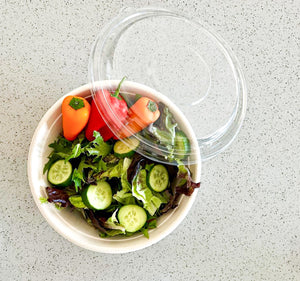
We've been very happy with these lids. They fit securely, are sturdy, and work perfectly with our salad bowls. Great quality product and reliable for takeaway and delivery orders. Will definitely purchase again.
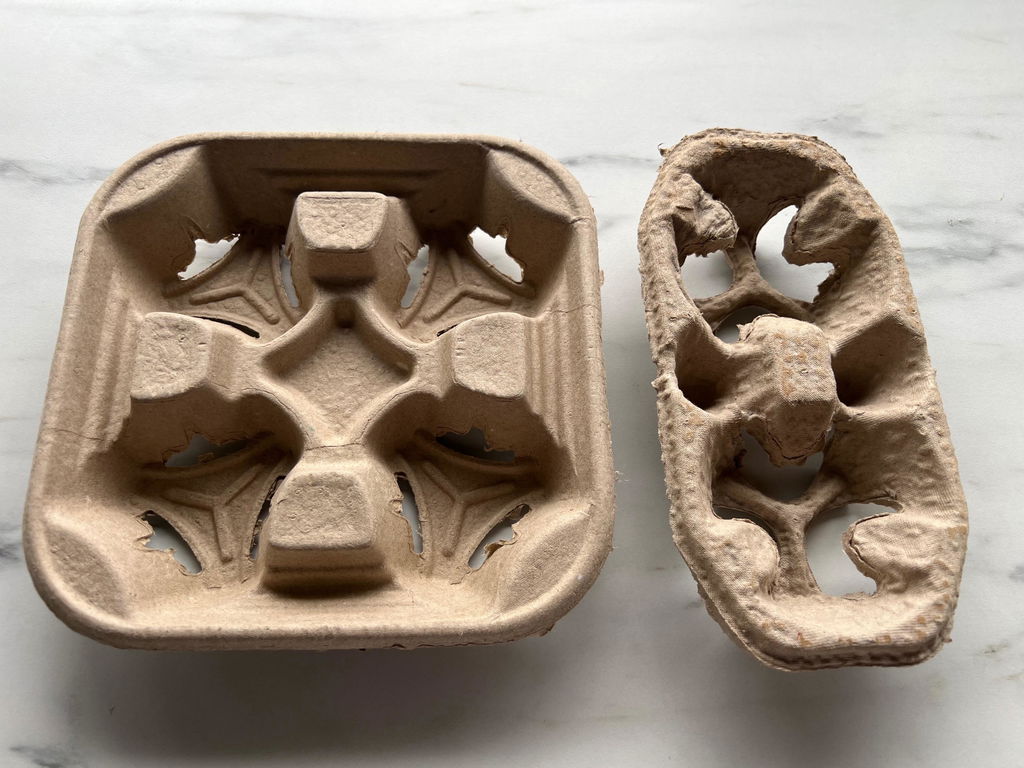
These are aesthetically ugly with brown stains, I get it probably recycled card pulp and it does the job of holding cups but I’m disappointed. Compared the 4 cup holders ones you sell, those are much nicer with cleaner edges and surfaces. I recommend you use the same supplier as the 4 cup design.